
Pardon the dust! We are working on this page.
About Wolves
What are the subspecies of the gray wolf?
The gray wolf, Canis lupus, lives in the northern latitudes around the world. There are five subspecies of the gray wolf in North America and seven to 12 in Eurasia. The currently recognized subspecies in North America are:
- Canis lupus baileyi, commonly referred to as the Mexican wolf or lobo.
- Canis lupus nubilus, referred to as the Great Plains or buffalo wolf.
- Canis lupus occidentalis, known as the Rocky Mountain wolf or Mackenzie Valley wolf.
- Canis lupus lycaon, commonly referred to as the eastern timber wolf.
- Canis lupus arctos, known as the arctic wolf.
Subspecies are often difficult to distinguish from one another. This is because they interbreed where their ranges overlap so that their populations tend to blend together rather than form distinctive boundaries. The different traits we see in subspecies are likely the result of geographic range, available habitat, and prey base. Skull dimensions, overall size, fur color, and the length of appendages are some of the characteristics that differ between subspecies of gray wolf.
In addition to gray wolves there are two other species of wolf in the world. The red wolf, Canis rufus, inhabits the southeastern United States and the newly recognized Abyssinian wolf, Canis simensis, lives on the highlands of Ethiopia.
How much do wolves weigh?
Adult female wolves in northern Minnesota weigh between 50 and 85 pounds, and adult males between 70 and 110 pounds. Wolves are larger in the northwestern United States, Canada, and Alaska where adult males weigh 85 to 115 pounds and occasionally reach 130 pounds. Females are usually 10 to 15 pounds lighter than males.
What do wolves eat?
Wild wolves prey primarily on large, hoofed mammals such as white-tailed deer, mule deer, moose, elk, caribou, bison, Dall sheep, musk oxen, and mountain goat. Medium sized mammals, such as beaver and snowshoe hare, can be an important secondary food source. Occasional wolves will prey on birds or small mammals. At Big Run we feed our wolves a mix of raw chicken, beef and (during the winter months) road-kill deer.
How much do wolves eat?
Wolves can survive on about two and a half pounds of food per wolf per day, but they require about five pounds per wolf per day to reproduce successfully. The most a wolf can eat in one sitting is about 22.5 pounds.
How long do wolves live?
Wolves in the wild have an average life span of six to eight years, but wolves have been known to live up to 13 years in the wild and 16 years in captivity.
What do wolves die from?
The natural causes of wolf mortality are primarily starvation, which kills mostly pups, and death from other wolves because of territory fights. While not usually a big problem, disease such as mange and canine parvovirus can be a concern in small and recovering populations. Injuries caused by prey results in some deaths. Human-caused mortality including legal, illegal, and accidental causes, can be high in some populations.
How strong are wolves jaws?
The massive molars and powerful jaws of a wolf are used to crush the bones of its prey. The biting capacity of a wolf is 1,500 pounds of pressure per square inch. The strength of a wolf’s jaws makes it possible to bite through a moose femur in six to eight bites. In comparison, a German shepherd has a biting pressure of 750 pounds per square inch. A human has a much lower biting pressure of 300 pounds per square inch.
How fast can wolves run?
Wolves will travel for long distances by trotting at about five miles per hour. They can run at speeds of 25 to 35 miles per hour for short bursts while chasing prey.
How far can wolves travel?
Wolves may travel 10 to 30 miles each day in search of food. Dispersing wolves, those leaving packs in search of their own mate, have been known to travel distances of 550 miles away form their home territory.
Wolves on the Web
Other Animal Information
Thanks to writer Al Smuskiewicz, who volunteered his time to research and compose all the articles about our various animals.
The Black Bear


The black bear (Ursus americanus) is the most common and widespread species of bear in North America. It is also the smallest of the three North American bear species.
North American Bears
Besides the black bear, the two other members of the bear family (Ursidae) that live in North America are the brown bear and polar bear. Various subspecies of brown bear (Ursus arctos)—some known as grizzly bears—live in the Rocky Mountains of the United States, western Canada, Alaska, Europe, and Asia. The polar bear (Ursus maritimus) lives throughout the Arctic.
Where Black Bears Live
Black bears live throughout Canada and Alaska and in at least 40 of the conterminous United States (the lower 48 states), including southern Illinois and northern Wisconsin and Michigan. The animals are less common in eastern and midwestern states than in western states. Black bears are rare in Mexico.
Black bear habitats include forests, swamps, and mountains. Within these habitats, black bears find shelter in dens under fallen trees, in hollow logs, in dense thickets of shrubs, and in caves.
The Black Bear’s Body
An adult black bear is usually five to six feet long from head to tail, and two to three feet high at the shoulders. Black bears typically weigh from 200 pounds to more than 500 pounds, with males (boars) weighing more than females (sows).
Black bears have feet that are plantigrade, meaning that they walk with both the heel and toes touching the ground. These are the same kind of feet that humans have—and black bears can stand and walk upright like humans for short distances. The claws on black bear feet are short, curved, and sharp.
Black bears are mostly black in the eastern part of their range. However, many black bears are cinnamon brown in the western part of their range, and some are even creamy white (along the coast of British Columbia) or bluish-gray (in southeastern Alaska).
Food
Black bears have an omnivorous (eating both plant and animal food) diet. Most of a black bear’s food comes from plants, including berries and other fruits, acorns, nuts, and grasses. Black bears can easily climb trees to reach high food.
Animal food eaten by black bears includes worms, insects, birds’ eggs, rodents and other small mammals, salmon and other fish, and (rarely) young deer and moose. When chasing prey, a black bear can maintain a speed of 30 miles per hour for short distances. Black bears will also eat dead animals.
In national parks and national forests, some black bears have learned to accept handouts from human visitors and to raid campgrounds and dumpsters for food. It is a bad idea for people to feed bears, because some bear-human encounters have led to injuries and even death for the humans.
Behavior
Black bears are most active at dawn and dusk, though they are sometimes out and about at mid-day. They normally live alone—except for breeding pairs in summer, mother bears with cubs, and temporary groups in especially rich feeding areas. In such a group, bears may form a social hierarchy, with dominant and submissive animals of the same sex.
Male black bears have large home ranges (areas in which they normally live) that overlap the smaller home ranges of several females. Black bears mark their territories by clawing at and biting trees and by leaving their scents on plants and rocks.
When black bears meet, they communicate with a variety of body signals, facial expressions, and vocalizations. If a black bear feels threatened, it may flatten its ears, lower its head, extend its lips, and let out a low moan or blow. If this behavior doesn’t make the threat go away, the bear may lunge toward the threat—and, if necessary, attack. Black bears growl loudly while fighting.
Hibernation
During the autumn, black bears consume large amounts of food and put on extra weight. This is especially true in far northern areas, where winters are very long and cold. In these areas, black bears remain inside their dens for most of the winter, sleeping and living off their fat reserves for weeks or months at a time. Before emerging from its den in spring, a black bear may lose more than 25 percent of its body weight.
Despite these long sleeps, many scientists do not consider black bears to be true hibernators. That is because, unlike such true hibernators as bats and ground squirrels, black bears do not experience dramatic drops in body temperature during their winter dormancy. In fact, black bears can quickly become active again when they are disturbed or when there are warm-ups in the winter weather.
In the more southern parts of their range, where winters are mild, black bears may be inactive for only brief periods during winter.
Reproduction
Black bears usually breed in June or July. In January or February, the female black bear gives birth to one to six (usually two) cubs in her winter den. The tiny cubs each weigh only about half a pound and are blind and hairless. Their eyes open when they are about a month old.
The cubs stay with their mother for a whole year, learning to hunt and forage from her. Adult male black bears play no role in raising the young. The cubs den with their mother through a second winter. When spring arrives, the young bears go out on their own.
Black bears usually become sexually mature between the ages of two and four years. If their nutrition is poor, however, some females may not begin breeding until they are as old as seven or eight. After reaching sexual maturity, a female black bear typically gives birth every other year.
Lifespan
Most black bears are full grown by the time they are about four years old, though some males may continue growing past age 10. Some black bears live more than 30 years in the wild, but most die at an earlier age. Many deaths of black bears are caused by gunshot wounds, traps, and automobiles.
Intelligence
Black bears are intelligent animals with large brains. Experiments have demonstrated that black bears have excellent long-term memories. Biologists have also observed that black bears are extremely curious about their surroundings and any new objects that they find. Black bears are easily trained for performances in movies and other forms of entertainment.
Black bears have amazing navigational abilities that are little understood by scientists. Some “nuisance” black bears (which got into such trouble as raiding garbage) have been trucked almost 170 miles away from their home ranges by wildlife managers—only to somehow find their way back.
Abundant Animals
Although black bears are not as abundant as they used to be in the eastern and midwestern states, these animals still exist in large numbers in nature. There are believed to be approximately 900,000 black bears in North America, including 300,000 in the United States. Hunting seasons in many states and Canadian provinces result in roughly 50,000 black bears being killed every year.
Article Written By: Alfred J. Smuskiewicz
MAIN SOURCES USED IN RESEARCH:
- World Book Online: Bear article, 2008
- David Burnie, Don E. Wilson, editors. Smithsonian Institution Animal. Dorling Kindersley Publishers, 2001
- Joseph A. Chapman, George A. Feldhamer, editors. Wild Mammals of North America. The Johns Hopkins University Press, 1982
- William H. Burt, Richard P. Grossenheider. A Field Guide to the Mammals. Houghton Mifflin Company, 1976
- http://ecos.fws.gov/speciesProfile/SpeciesReport.do?spcode=A0G1
- http://www.defenders.org/wildlife_and_habitat/wildlife/black_bear.php
- http://animaldiversity.ummz.umich.edu/site/accounts/information/Ursus_americanus.html
- http://www.iucnredlist.org/search/details/41687.pdf
- http://www.bear.org/Black/Black_Bear_Facts.html
- http://www.mass.gov/dfwele/dfw/wildlife/facts/mammals/bear/black_bear_biology_faq.htm
- http://www.bear.org/Black/Articles/Home_Sweet_Smelling_Home.html
- http://www.squidoo.com/blackbears
The Cougar
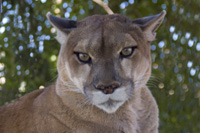
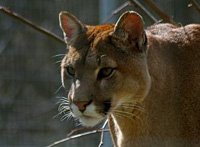
The cougar (Puma [or Felis] concolor) is a cat of many names. Mountain lion, panther, puma, painter, and catamount are some of the other names used to refer to this species.
Cougars and Other Cats
The cougar is the second largest member of the cat family (Felidae) in the Western Hemisphere. The only cat in the Americas that is larger is the jaguar, of Central and South America.
There are as many as 30, or as few as 6, subspecies of cougars—depending on the scientist doing the classifying. The name “panther” is commonly used to refer to a cougar subspecies in Florida. However, “panther” is also used to refer to the leopard (Panthera pardus), an entirely different species that lives in Asia and Africa. The “black panther” is a leopard with a genetic mutation that makes its skin and fur contain large amounts of a dark pigment called melanin.
Where Cougars Live
The cougar is the most widely distributed carnivore in the Western Hemisphere, living from southern Canada to southern South America. In the United States, it is found mostly in the western states, from the Rocky Mountains to California. Cougars live in a variety of habitats, including mountains, coniferous and deciduous forests, grasslands, deserts, and swamps.
The Cougar’s Body
The cougar’s body, not counting the tail, may be 6 feet in length. The tail adds another 2 to 3 feet to the animal’s length. Cougars have long muscular legs, which allow them to run as fast as 35 miles per hour and to leap as high as 18 feet. Cougars typically weigh between 110 and 200 pounds, with males being heavier than females.
The cougar’s coat is plain, with no spots or stripes—which is unusual for a wild cat. The animal’s fur color varies from tawny to reddish to silvery gray. Its throat and belly are white.
Food
The hunting strategy of the cougar usually consists of carefully stalking its prey under cover and then suddenly leaping out at it. The cougar grabs its prey with the sharp claws of its front paws and then bites the animal’s neck to break it. The prey is dragged to a sheltered spot, such as under a tree or rock overhang, where the cougar can eat it in peace.
The cougar’s diet includes both large and small animals, such as deer, bighorn sheep, elk, moose, wild hogs, rabbits, and mice. Cougars even eat porcupines—with the quills! Cougars often store uneaten food in caches, covered with dirt, to be eaten later.
Behavior
Cougars may hunt during the day or night, though they are most active around dusk and dawn. They tend to be solitary and secretive animals, except for mating time. They use thick brush, rocky crevices, or caves as shelter when they want to rest or protect themselves from bad weather.
The home range (the area in which an animal normally lives) of a cougar may be larger than 125 square miles. A cougar marks its territory with various kinds of signs to warn other cougars to stay out, such as scrapes in the dirt or snow, scratched logs, piles of leaves, and urine and feces. However, the large home range of a male may overlap the smaller homes ranges of several females.
Vocalizations
Unlike most other large wild cats, the cougar does not roar. But it does growl, whistle, hiss, and purr. In addition, females ready to mate sometimes make a loud eerie cry that resembles the sound of a person screaming.
Reproduction
Cougars may breed at any time of the year. A male typically mates with several females during the year. A female typically mates once every two to three years.
Approximately 90 days after mating, the female gives birth to one to six (usually two or three) kittens in a secluded den among rocks, in a thicket, or in some other sheltered place. The kittens weigh only about one pound at birth and have their eyes and ears closed until they are one or two weeks old. Kittens nurse for five or six weeks before they can eat solid food.
Cougar kittens have light-colored fur with large brownish-blackish spots, which fade away by the time the cat is six months old. The mother cougar may take care of her offspring for as long as two years, teaching them to hunt and to defend themselves. Male cougars play no role in caring for offspring, and they may even kill their own kittens should they come across them. Cougars are able to breed when they are two or three years old.
Lifespan
Cougars usually live between 12 and 20 years. There are no predators that attack cougars. However, cougars are sometimes killed in struggles with large prey. For example, an elk might kill a cougar with its antlers or hooves. The main threats to cougar survival come from harmful human activities.
Cougar Populations in the United States
Cougars have been eliminated from roughly two-thirds of their historic range in North America, mainly as a result of habitat destruction, hunting, and killings by automobiles. These large cats once roamed throughout the United States, from the east coast to the west coast. Today, however, they remain relatively common in only the Rocky Mountains region and the states west of these mountains. Since the 1960’s, when many western states instituted hunting restrictions and eliminated bounties on cougars, the populations of cougars in this region have been increasing.
There are no known breeding populations of cougars in the states east of the Rocky Mountains—except for southern Florida, where approximately 60 members of the Florida panther subspecies (Puma concolor coryi) live. The survival of this highly endangered subspecies is at risk because of destruction of its habitat by human development and contamination of its habitat by agricultural and residential pesticides. Inbreeding, which makes animals more susceptible to disease, also places the Florida panther’s survival at risk.
In recent years, there have been scattered sightings of individual cougars in a number of states in the southeastern and midwestern regions of the United States, including southern and western Illinois. Scientists believe that these sightings may be evidence that cougars are beginning to naturally re-establish themselves in these areas.
Article Written By: Alfred J. Smuskiewicz
MAIN SOURCES USED IN RESEARCH:
- World Book Online: Cougar, Panther articles, 2008.
- David Burnie, Don E. Wilson, editors. Smithsonian Institution Animal. Dorling Kindersley Publishers, 2001.
- Joseph A. Chapman, George A. Feldhamer, editors. Wild Mammals of North America. The Johns Hopkins University Press, 1982.
- William H. Burt, Richard P. Grossenheider. A Field Guide to the Mammals. Houghton Mifflin Company, 1976.
- http://www.nwf.org/cats/pdfs/catsreport.pdf
- http://ecos.fws.gov/speciesProfile/SpeciesReport.do?spcode=A046
- http://www.easterncougarnet.org/cougarfacts.html
- http://www.easterncougarnet.org/bigpicture.html
- http://www.easterncougarnet.org/prairiestates.html
- http://www.bigcatrescue.org/cats/wild/cougar.htm
- http://www.nwf.org/cats/pdfs/cougarfacts.pdf
- http://www.nwf.org/cats/pdfs/flpantherfacts.pdf
- http://www.sandiegozoo.org/animalbytes/t-puma.html